Creating a Comprehensive SEO Content Strategy Framework for 2026

SEO doesn’t look much like it did a few years ago. AI Overviews and zero-click answer tools now pull details straight into the results page. That pushes content teams to step back and rethink what success really means. Showing up inside answers, summaries, and recommendations matters more than holding a blue link at position three. This shift affects how teams plan their work, track results, and talk about SEO value with stakeholders, and yes, those talks feel different now. A strong SEO content strategy helps navigate these changes effectively.
What works today isn’t pumping out more pages at a faster pace. Strong SEO content strategies focus on a structure that can grow, clearly show real expertise, and appear across both classic search results and AI-driven experiences. This is where many teams feel stuck. Read on to find out how to build a full SEO content strategy framework for 2026.
Why Your SEO Content Strategy Needs a Framework
Random blog posts once had a chance. But search engines now read content as part of a connected system, not single pages. They reward sites that show clear structure, regular focus, and intent that matches how people actually search, not internal ideas or guesses. Many teams already feel this change, especially when traffic drops with no clear reason why.
The numbers back this up:
- 85% of marketers now use AI in their content workflows, and about 45% of new web content includes AI.
- Even with all that output, only 12% of content reaches the top 10 results, and 68.1% of searches end without a click because AI answers and rich results take over.
The issue is direction. Teams without a framework publish fast, but their content drifts and rarely gains traction. Teams working from a framework build topical authority gradually and send consistent E-E-A-T signals – the result is visibility across a broader range of search results.
The framework sets the guardrails: topic selection, AI’s role, editorial oversight, success metrics. Try scaling SEO content in 2026 without it and the process quickly becomes inefficient, and the risks compound.
Building the Foundation: Goals, Search Intent, and Topic Architecture
SEO best practice starts with two early answers: what you want to achieve and who the content is for. Teams often move too fast here. Search intent guides everything that comes next, including how a page is written and why someone clicks it in the first place.
Business goals work best when they clearly match intent. For example:
- Awareness goals pair well with informational and educational searches that explain ideas or point out problems you want readers to notice.
- Consideration and conversion goals often appear in comparison searches, solution‑focused content, and transactional or high‑intent pages where people are ready to decide.
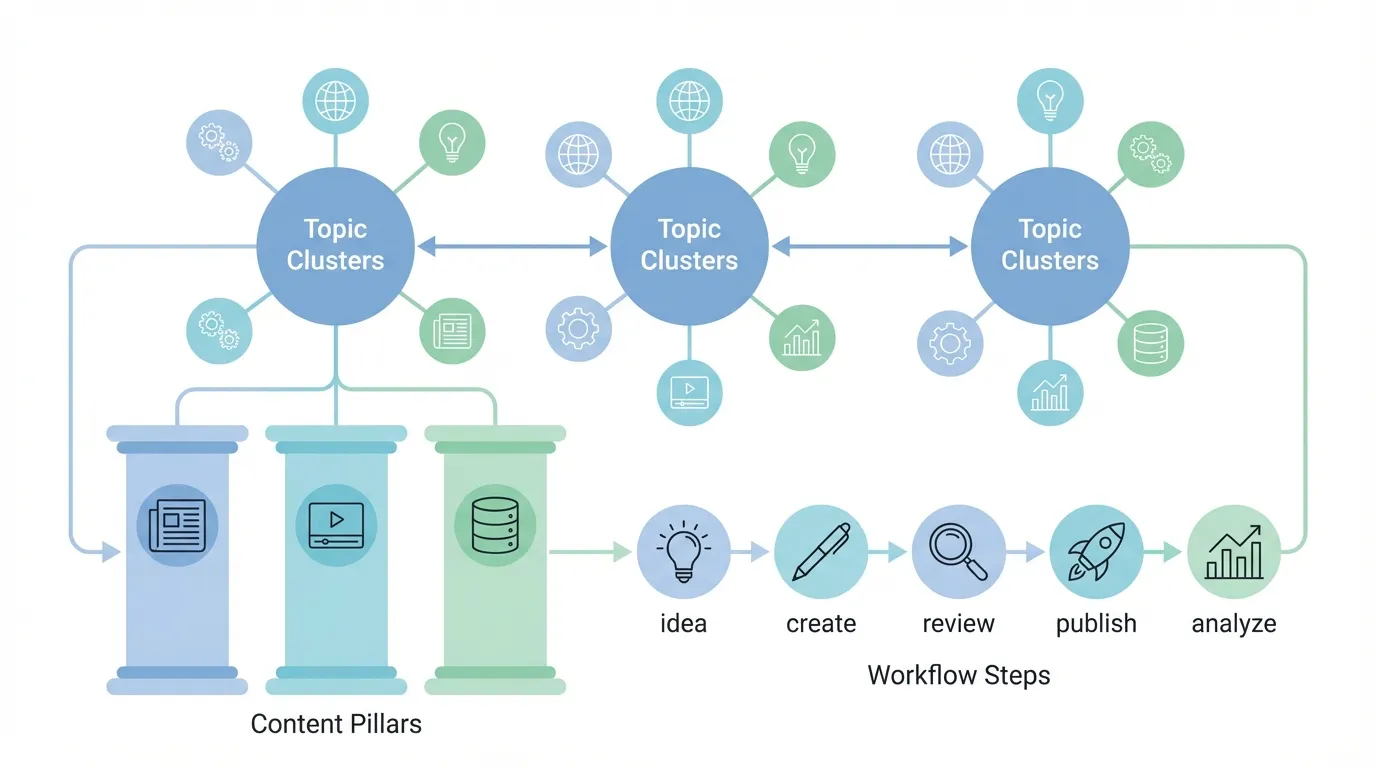
Once this link is clear, single keywords lose a lot of value. Topic clusters and semantic groupings give AI tools clearer direction and help avoid thin or uneven content. Search engines also respond better to real depth around a topic instead of a loose set of unrelated pages.
Main topics usually live on pillar pages. Supporting articles branch out to answer related questions at different intent levels. Some stay broad, while others zoom in on specific needs that truly help readers.
To keep everything on track, teams often use structured calendars for consistency. When timing and seasonality matter, a resource like Creating a Dynamic Content Calendar: Integrating AI and Human Insights in 2026 fits naturally into the planning process. Additionally, you can explore Multilingual SEO Content Planning: A Complete Workflow for AI-Human Teams to extend your strategy globally.
Designing Scalable AI-Human Content Workflows
Quality and trust are the main pressure points in SEO right now. Teams aren’t asking if they should use AI anymore. They’re working out how to use it without losing their voice or taking shortcuts.
By 2026, the most reliable setups follow a clear split of work that’s easy to manage day to day:
- AI handles research, keyword grouping, outlines, and early drafts.
- Humans add real-world context, make judgment calls, check facts, and shape a tone readers actually connect with.
The results support this approach. Human-edited AI content performs almost as well as fully human-written content, with only a small gap. That likely explains why 86% of marketers say they edit AI outputs to build stronger expertise and trust.
If your team is just getting started, we break this down in the Beginner’s Guide to Hybrid AI-Human Content Workflows.
E-E-A-T Content Analysis as a Core SEO Best Practice
AI-powered search makes the gap clear fast: content without real E-E-A-T – experience, expertise, authority, or trust – drops before teams even see it coming. Pages that don’t show these signals have a hard time staying visible.
A strong E-E-A-T content analysis looks at practical signals, including:
- Clear authorship, with real, checkable credentials readers can confirm
- First-hand experience that reads naturally, not pasted in later
- Information that’s accurate, up to date, and reviewed instead of carried over
- Ongoing updates over time, rather than posting once and forgetting it
The stakes are higher for YMYL and B2B sites. Pages with strong E-E-A-T signals see an average 67% ranking improvement over weaker competitors, and that gap keeps growing each year. For more on this, have a look at E-E-A-T Optimization Techniques for AI Content in 2026.
Technical SEO and Search Experience Optimization
A good content plan can still fall short if the technical foundation isn’t solid. Technical SEO now reaches past crawl access. It looks at how people and automated systems read and understand a page, often at the same time.
You see this in everyday details:
- HTML that AI systems can read cleanly, without friction
- Fast load times on phones, desktops, and mixed devices, since slow pages rarely show up
- Schema that supports authorship, content types, and wider context
- Headings that are clear and direct, without filler
Around 68% of searches now end without a click. Pages still get seen, summarized, and quoted even when no visit happens. So the focus shifts to AI summaries and answer engines as a normal part of search. This idea is explored further here: Technical SEO for AI-Generated Content: Advanced Tactics for 2026, where technical work connects directly to how content appears in AI-driven results.

How to Measure Scalable SEO Tactics
Teams get more insight by looking beyond raw clicks and tracking impact tied to results, not vanity numbers. A narrow focus leads to gaps, especially as search habits keep changing.
More helpful reporting often includes metrics like these, which can show patterns traffic alone can’t:
- AI citation frequency, showing which pages get referenced
- Visibility inside AI Overviews, where early signals show up
- How content supports assisted conversions across journeys
- Engagement depth, including scroll behavior, to spot real interest
AI-driven search traffic is growing fast, with year-over-year gains over 500% in some verticals. Teams that adjust reporting early can see which pages support business goals and which don’t, cutting guesswork.
SEOContentWriters is an all-in-one SEO platform that supports this approach. Its AI-powered content creation with human editorial review helps teams grow content, keep quality consistent, and measure results the same way each time.
Questions, Answered
It focuses on how planning, creation, optimization, and tracking work as one flow, across planning cycles and regular measurement. For 2026, it includes AI, human workflows and E‑E‑A‑T standards, tied closely to search experience optimization, not separate tasks.
AI speeds up research and writing at scale. Accuracy, real experience, brand voice, and trust still come from people. Using both keeps things fast without losing what readers depend on.
E‑E‑A‑T acts like a gatekeeper for AI-powered search, deciding what appears and what doesn’t. Pages without real experience often struggle to gain authority in these systems.
Good teams check content every few months. These updates help to keep content accurate and, over time, make it easier for readers to trust what they read.
Your SEO Content Strategy in 2026
A good SEO content strategy for 2026 comes down to building a system that actually lasts. Speed matters, but not without quality, and trust stays at the center (that part hasn’t changed). AI helps teams move faster and cover more ground. Human judgment keeps content accurate, useful, and believable. E‑E‑A‑T connects these pieces in a clear, workable way.
For many teams, starting small works best. Core topics come first. The AI‑human workflow gets written down, along with clear quality rules, so everyone follows the same playbook. Technical setup and measurement follow. Over time, that structure becomes a real edge instead of extra busywork.
Ranking well, earning citations, and helping readers all depend on how the strategy is built. Teams that get this right in 2026 won’t just keep up. SEOContentWriters is an all-in-one platform that handles all aspects of this strategy for you. Get started in minutes now and let AI + human editors handle your content creation.